
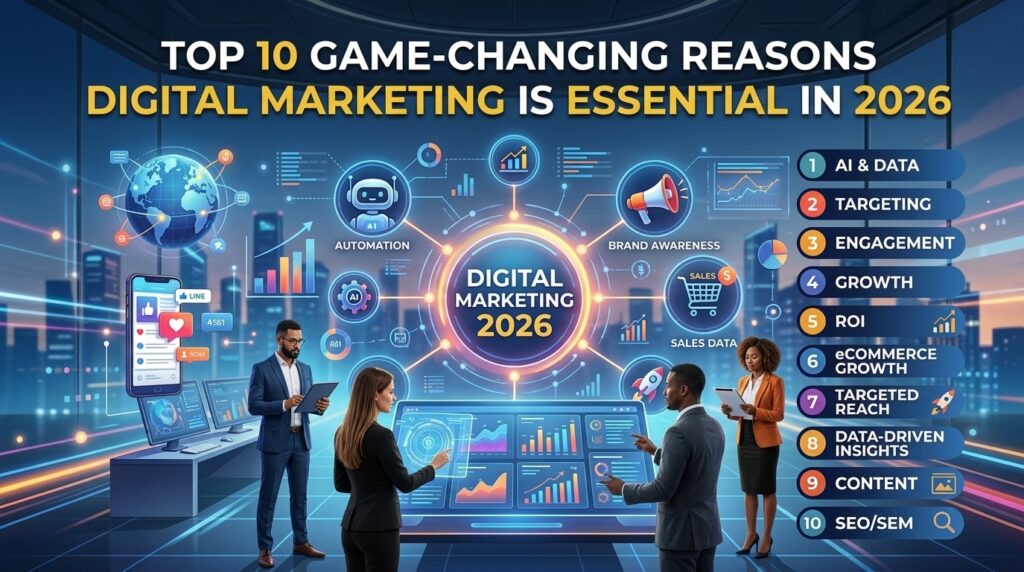
Top 10 Game-Changing Reasons Digital Marketing is Essential in 2026
The business world has changed dramatically. What worked just a few years ago in marketing is no longer enough to stay ahead. In 2026, digital marketing is no longer just a helpful tool for growing a business—it is the backbone of modern commerce.
Whether you are running a local shop, leading a growing startup, or managing an established global brand, how you present yourself online determines your success. Here are the top 10 game-changing reasons why digital marketing is absolutely essential in 2026.
1. Hyper-Personalization Powered by Artificial Intelligence
Generic, one-size-fits-all advertising is effectively dead. In 2026, customers expect brands to understand their exact needs, preferences, and buying habits in real time.
Digital marketing platforms now use advanced artificial intelligence to analyze consumer behavior instantly. This allows businesses to send personalized product recommendations, custom email messages, and targeted discounts to individual customers at the exact moment they are ready to buy. This level of personal connection builds trust and keeps buyers coming back.
2. Voice and Visual Search Have Taken Over
The way people look for information online has evolved. Instead of typing short phrases into a search box, millions of consumers daily rely on voice assistants like Alexa and Siri, or simply take a photo of an item using visual search tools to find where to buy it.
Digital marketing in 2026 ensures your business is optimized for these conversational search queries and visual matches. If your website and content aren’t prepared for voice and visual search, you are missing out on a massive portion of modern web traffic.
3. Immersive Customer Experiences (AR & Virtual Reality)
Shopping online is no longer a passive experience of scrolling through static photo galleries. Augmented Reality (AR) and Virtual Reality (VR) are now mainstream marketing channels.
Consumers today expect to “try before they buy.” Through modern digital marketing strategies, customers can:
Preview how furniture looks inside their actual living room using their phone camera.
Virtually try on clothing, glasses, or makeup.
Take interactive 3D tours of locations, events, or real estate properties.
By adopting these interactive technologies, businesses reduce product return rates and boost overall customer satisfaction.
4. Unrivaled Cost Efficiency and Measurable ROI
Traditional media—such as billboards, television ads, and magazine prints—requires high upfront costs with very little guaranteed return. More importantly, tracking exact results from traditional media is nearly impossible.
Digital marketing levels the playing field. With online campaigns, every dollar spent can be tracked. You can see precisely:
How many people viewed your ad.
Who clicked on it.
How many sales resulted from that specific campaign.
This degree of tracking allows small and medium-sized businesses to optimize their budgets in real time, ensuring maximum return on investment (ROI).
5. Micro-Influencer and Creator-Led Credibility
Big celebrity endorsements have largely lost their impact. Today’s consumers value authenticity over polished advertisements. This has given rise to the dominance of micro-influencers—content creators with smaller, highly dedicated followings focused on specific niches.
Modern digital marketing relies heavily on building genuine creator partnerships. When a trusted voice in a niche reviews or recommends your product, their audience listens. It provides instant social proof that traditional advertising simply cannot buy.
6. Social Commerce: Buying in the Moment
In 2026, social media platforms are no longer just places to share photos or connect with friends—they are complete digital marketplaces.
Through social commerce, users can discover a product, read reviews, select their size, and pay for their purchase without ever leaving their favorite app. Digital marketing bridges the gap between discovery and purchase, removing friction and making impulse buying seamless for consumers.
7. Data Privacy Trust as a Competitive Advantage
With stricter global privacy regulations and the total phase-out of third-party tracking cookies, consumers are more cautious than ever about how their personal data is handled.
Digital marketing strategies in 2026 focus heavily on first-party data—information given directly and willingly by customers through subscriptions, surveys, and account creation. Brands that practice transparent, ethical data management earn strong consumer trust, turning privacy protection into a powerful brand asset.
8. Real-Time Engagement and Instant Customer Support
In a fast-paced digital world, customers expect rapid answers. If someone asks a question on your social page or website and has to wait days for an email reply, they will simply go to a competitor.
Modern digital marketing combines AI-driven chatbots with live support teams to deliver instant 24/7 engagement. Whether resolving a issue, answering a product question, or guiding a shopper through checkout, real-time communication builds loyalty and keeps sales flowing around the clock.
9. Laser-Focused Audience Targeting
In the past, marketing was like throwing a net into the ocean and hoping to catch the right fish. Digital marketing gives you a spear.
Instead of paying to display your business to everyone in a city, modern advertising platforms allow you to target people based on precise criteria, such as:
Specific age groups, locations, and languages.
Hobbies, personal interests, and online habits.
Past purchasing behavior and intent to buy.
This targeted approach ensures your advertising dollars are spent exclusively on reaching people who are actually interested in what you sell.
10. Agility to Adapt to Market Changes Instantly
Markets shift quickly, consumer trends change overnight, and unexpected global events can alter business landscapes in days. Traditional marketing campaigns take months to plan, produce, and distribute, making them rigid and slow to adapt.
Digital marketing offers unmatched agility. If a new trend emerges today, you can publish a video, update your website, or launch a targeted ad campaign within hours. If an ad isn’t performing well, you can pause it, adjust the message, and re-launch it immediately without wasting money.
Key Takeaways for Businesses in 2026
To help summarize where to focus your marketing efforts this year, here is a quick overview of key channels and their primary advantages:
| Marketing Strategy | Main Focus | Primary Benefit |
| AI Personalization | Tailored recommendations & content | Higher conversion rates & loyalty |
| Social Commerce | Direct buying within social apps | Faster sales with zero friction |
| AR / Interactive Media | Virtual try-ons & product previews | Reduced returns & higher engagement |
| Micro-Influencers | Niche creator partnerships | Authentic trust & high credibility |
| First-Party Data | Transparent, privacy-first marketing | Long-term customer trust |
Final Thoughts
Digital marketing in 2026 is no longer an option reserved for tech-savvy companies—it is a core necessity for business survival and growth.
By embracing artificial intelligence, interactive content, direct social purchasing, and authentic creator partnerships, your business can connect with customers in meaningful ways. The digital world moves fast, but with a clear, modern digital marketing strategy, your brand can stay visible, competitive, and successful for years to come.